

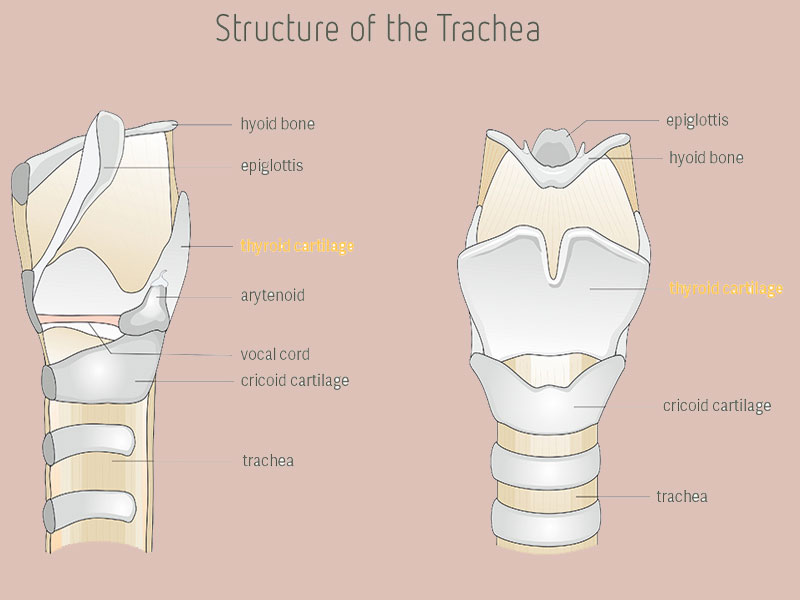
Chondrolaryngoplasty also known as Tracheal Shaving, Adam Apple’s Reduction, or thyroid cartilage reduction. is a kind of cosmetic surgery performed for transgender woman (male to female) for whom the Adam Apple serves as a masculine marker and they tend to have a face that looks more feminine. This procedure is not only for transgenders but also for non-binary and cisgender women who want the same effect. Upon reaching puberty, the larynx and thyroid cartilage grows bigger in male gender. So, this surgery is a way to reduce or shave the thyroid cartilage prominence, thereby minimizing the appearance of this male physical characteristic. For people who are transitioning from male to female, having a tracheal shave can be emancipative and empowering. During this procedure thyroid cartilage is removed from the larynx. Thyroid cartilage protects the vocal cords.
Why is Chondrolaryngoplasty performed?
As mentioned earlier, upon reaching puberty, hormones like testosterone increase the size of Adam Apple and larynx. On the other hand, the vocal cords get longer and the voice may crack during this time. So these changes deepen the voice and cause the formation of a prominent bump in the front of the throat. This surgical technique will make the entire face appear more feminine.
How is the procedure?
Before the procedure the doctor evaluates you for the surgery including electrocardiogram (EKG) and blood tests. Chondrolaryngoplasty can be performed under either local anesthesia with sedation or general anesthesia with endotracheal intubation. Local anesthesia works well, although potential disadvantages of this anesthetic approach include patient anxiety and increased surgical difficulty owing to poor patient cooperation or reflexive coughing and swallowing. After the surgical field is cleaned and prepared with an iodine-based surgical preparation, the thyroid cartilage notch or Adam’s apple is marked with a surgical marker. An incision in the crease of the Cervi omental angle of approximately 2 cm is marked. If a deep neck rhytid is present overlying the larynx, the patient is presented with the option of making the surgical incision within this rhytid. The incision is made, and subcutaneous dissection is performed to the area of the thyroid cartilage. Blunt dissection between the strap muscles exposes the overlying perichondrium of the thyroid cartilage. An incision is made through the perichondrium along the anterior angle of the thyroid cartilage, extending to the left and right superiorly along the superior edge of the cartilage.
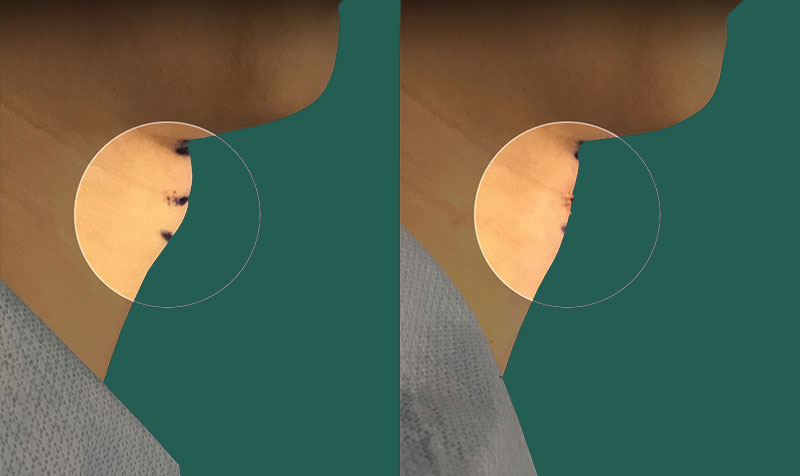
Subperichondrial dissection is then performed to expose the cartilage. A curved hook is placed on the posterior surface of the thyroid cartilage in the midline at the base of the notch, and superior-to-anterior retraction is performed. Then a small camera will be inserted into the incision in order to locate the vocal cords and thyroid cartilage. Then the thyroid cartilage will be removed. it is necessary to accept a less-than-ideal cosmetic result rather than to risk lowering the voice. On occasion, it may be possible to shave part of the projecting cartilage (less than full thickness), although this procedure subjects the patient’s voice to increased risk and is not recommended for the surgeon who only occasionally performs chondrolaryngoplasty. When the surgery is completed, the incision will be sutured and closed.
What to expect after Chondrolaryngoplasty surgery?
Swelling
After Chondrolaryngoplasty, there may be swelling for 24 to 48 hours. However, it may last for up to 6 weeks and it’s totally normal.
Pain
The pain that you may experience after this surgery can be the same as throat infection. It is difficult to talk and swallow, and you have a burning sensation in your throat. This pain can last for about seven to ten days.
Scar
Just like the other surgeries, at first the scar will be a little red and perceptible, but after a year just a narrow soft line that will hardly be observable.
Air under the skin
Very often it’s unavoidable that a little hole towards the windpipe is created during a tracheal shave. This will, of course, be closed by a suture. But it’s entirely normal that some air will escape from the windpipe during speech or coughing. However, after a few days or weeks this will heal on its own without any treatment.
Side Effects of Chondrolaryngoplasty
The side effects of this surgery are as follows:
- Mild pain
- Inflammation
- Bruising
- Sore throat
- Weak voice
- Difficulty swallowing and talking
Recovery After Chondrolaryngoplasty
Postoperatively, a pressure bandage with light pressure can be applied briefly to reduce the risk of bleeding. After shrinking the Adam’s apple, it is advisable to restrict speaking. The moderate pain can be managed well with mild to moderate pain relievers. The sutures are removed after 7-14 days, depending on the seam technique. Postoperative scar care is important in order to ensure the most inconspicuous scar healing possible. You should avoid hair epilation next to the incision until your surgeon recommends continuing. Most procedures leave a distinctive red scar initially that should clear up over the next 1 to 3 months. A year after the procedure, you should only see a thin white line.
