

Female-to-Male sex reassignment is a type of sex reassignment that can take many forms, including a mastectomy and a change of penis. In this article, we look at gender reassignment surgeries. Sex reassignment surgery refers to procedures that help people transition to their self-identified gender. People may have surgery so that their physical body matches their gender identity. Gender dysphoria is the distress that occurs when your sex assigned at birth does not match your gender identity.
Facial masculine surgery
Men’s Facial Surgery (FMS) refers to a wide range of procedures that can give a person a more masculine, cut-out appearance. Because facial features provide important visual cues about a person’s gender, FMS is one of the most important gender reassignment surgeries. Every patient with FMS has unique goals and needs. In general, FMS may be a combination of forehead lengthening or enlargement, cheek enlargement, rhinoplasty, chin reshaping, jaw contouring, and thyroid cartilage strengthening.
Gender reassignment surgery
Before undergoing gender reassignment surgery, a person receives testosterone replacement therapy. Then, one or more of the following operations may be performed on him.
Breast Reconstruction
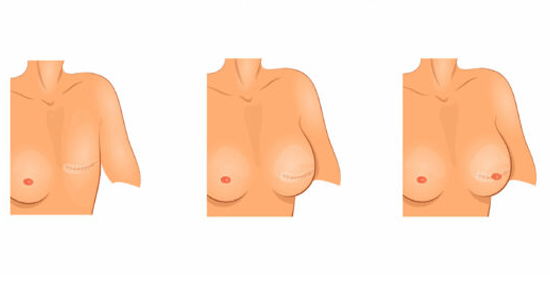
A person who is going to undergo gender reassignment surgery should have a subcutaneous mastectomy to empty his breast tissue. The surgeon also makes changes to the appearance and location of the nipples. Meanwhile, testosterone treatment stimulates breast hair growth.
Hysterectomy
If the person does not want to have a uterus, ovaries, and fallopian tubes, or if hormone therapy does not interrupt menstruation, surgery to remove the uterus, ovaries, and fallopian tubes are performed. In a partial hysterectomy, the surgeon removes only the uterus; In a complete hysterectomy, the cervix is also removed.
Metoidioplasty
Metoidioplasty is a method of making a penis. Before doing this, the person receives hormones to enlarge the clitoris and prepare for this purpose. During the operation, the surgeon also removes the vagina. In addition, it inserts the ureter into the penis and increases its length. Another option is Centurion surgery, which involves changing the position of the annular ligaments below the clitoris to increase the diameter of the penis. Metoidioplasty takes 2 to 5 hours. After the initial operation, further operations may be needed. The operation of the centurion takes about 2.5 hours, and the removal of the female reproductive organs may increase this time. The benefit of metoidioplasty is that the penis can get an erection on its own, but it is small in size.
Phalloplasty
In phalloplasty, grafted skin, usually taken from the arm, thigh, back, or abdomen, is used to form a new penis. Doctors consider arm skin the best option for making a penis. The penis produced by this method is larger than that of metoidioplasty, but it does not get an erection on its own. To solve this problem, after a recovery period, a genital implant is performed. In phalloplasty, the surgeon performs a vaginectomy (removal of the vagina) to increase the length of the ureter. One of the disadvantages of phalloplasty is that it has to be operated on several times, and as a result, it has to pay more than metoidioplasty.
Scrotoplasty
In addition to metoidioplasty or phalloplasty, a person may want to have a scrotoplasty, which involves making a scrotum. In this operation, the surgeon changes the location of the large edge to create a scrotum and then inserts silicone testicular implants into the scrotum.
Convalescence
The recovery period for gender reassignment surgery varies depending on the type of surgery performed and the individual’s general health and lifestyle. For example, smoking prolongs the recovery period and increases the risk of complicating surgery. Even doctors may not recommend this procedure for people who smoke, e-cigarettes or nicotine. After the sex change operation, the person must be hospitalized for at least a few days. After discharge, the person should rest completely for about 6 weeks and do very little activity. Also, due to the increase in ureter length, the catheter should be used for 3 to 4 weeks. Some of the complications that may occur with metoidioplasty or phalloplasty include the following :
Ureteral fistula: A tunnel-like connection that forms between the ureter and another part of the body;
Ureteral stenosis: A narrow ureteral pathway that blocks the flow of urine into the ureter.
A person undergoing phalloplasty may experience the following:
Wounding of the part where the skin has been removed; Skin graft or dead skin dysfunction.
Risks of scrotoplasty include rejection of testicular implants.
All types of gender reassignment procedures involve the following risks:
- Infection;
- Bleeding;
- Anesthesia allergy;
- Dissatisfaction with the result of the action.
